Flexographic printing has evolved dramatically over the past two decades, and few technologies have influenced that evolution more than UV curing. What began with traditional mercury (Hg) arc lamps is now rapidly shifting toward UV LED curing, especially in narrow‑web label and flexible packaging applications.
LED adoption continues to accelerate, however, mercury UV has not disappeared. Each technology offers distinct advantages and limitations. Understanding how they differ from a printing, ink, and operational perspective is essential when making equipment or ink system decisions.
This article provides a practical, side‑by‑side comparison of mercury UV vs. LED UV curing for flexographic printing, focusing on performance, ink chemistry, cost, and application fit.
How the Two Technologies Work:
Mercury (Hg) UV Curing
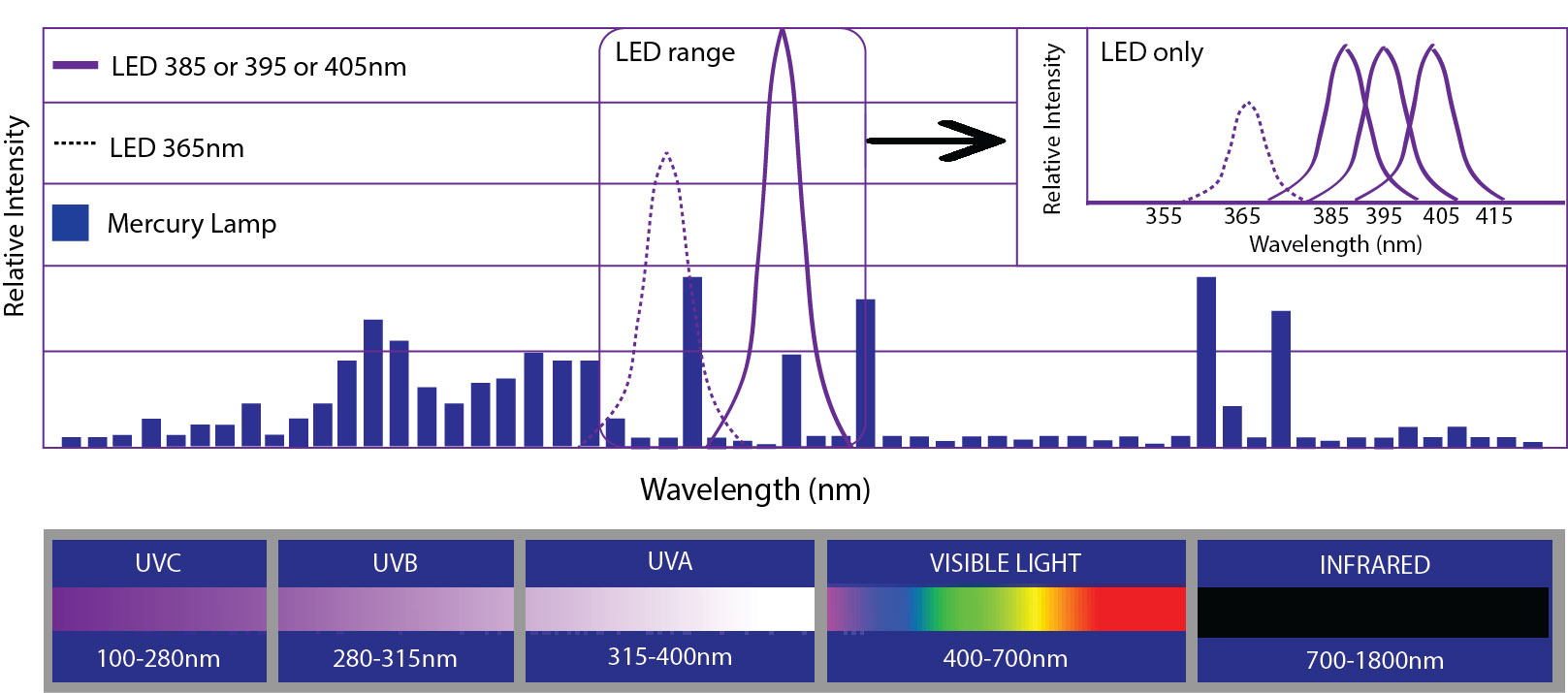
Mercury UV systems use medium‑pressure arc lamps that emit a broad spectrum of ultraviolet energy, typically spanning UV‑C, UV‑B, and UV‑A wavelengths (approximately 200–400 nm). This wide spectral output activates a broad photoinitiator range, which historically made mercury UV the industry standard for flexographic UV printing.
Because of this broad spectrum, mercury UV systems tend to be forgiving across different colors and coating thicknesses.
LED UV Curing
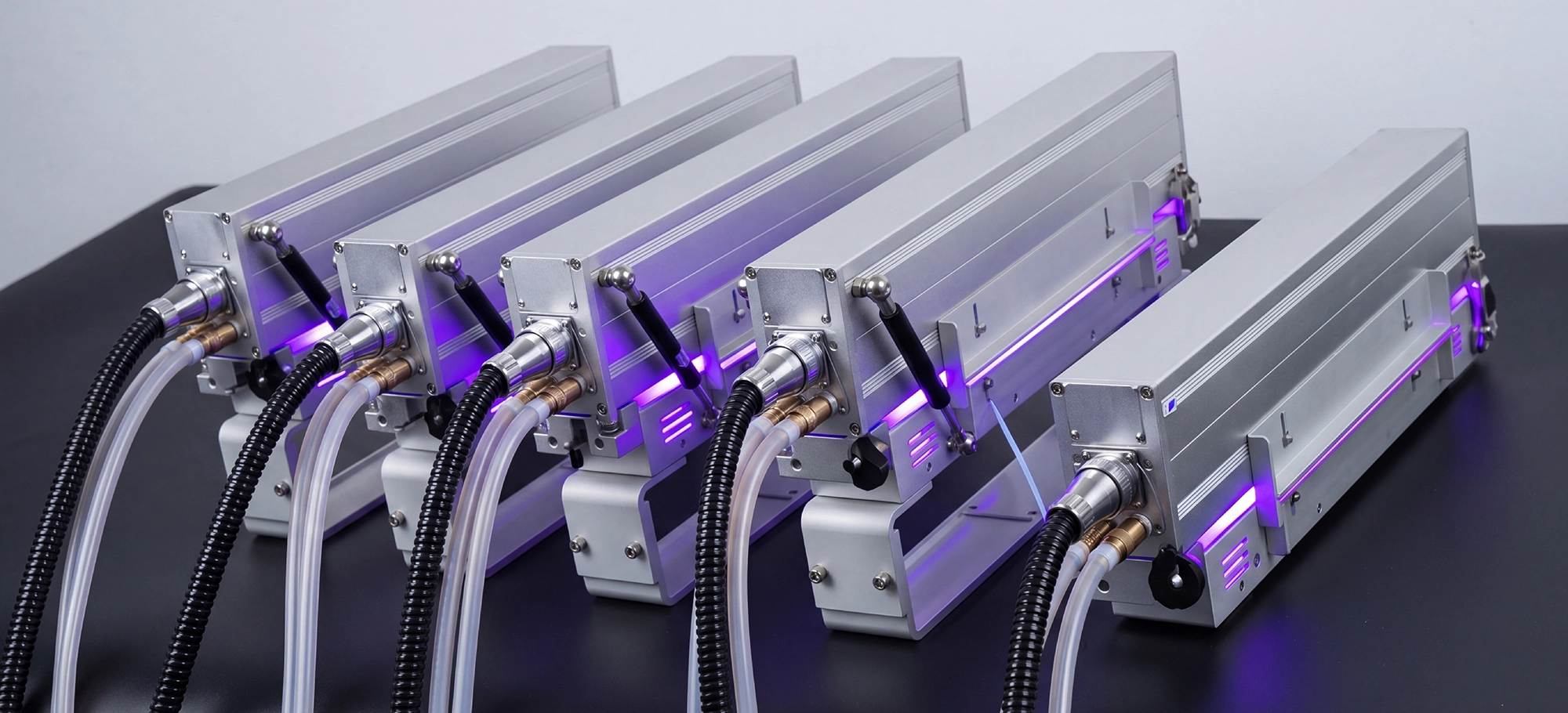
LED UV systems use arrays of light‑emitting diodes that produce narrow‑band UV‑A energy, most commonly at 365 nm, 385 nm, or 395 nm. Unlike mercury lamps, LEDs do not emit short‑wave UV or infrared radiation, creating what is often described as a “cold cure” process. This narrow wavelength output means LED curing relies on carefully matched ink chemistry, particularly photoinitiator selection.
Ink Chemistry Differences
The most significant difference between mercury and LED curing lies in the photoinitiator package.
Mercury UV Inks
- Utilize mixed photoinitiator packages; Type I and Type II
- Can respond to multiple UV wavelengths
- Easier to formulate for thick films, opaque whites, dense blacks, and cold‑foil adhesives
- More tolerant of press variability such as anilox volume or pigment concentration
Mercury systems benefit from short‑wave UV that promotes strong surface cure while longer wavelengths drive depth cure, giving a wide processing window.
LED UV Inks
- Require LED‑specific photoinitiators, typically Type I.
- Must be matched precisely to lamp wavelength
- Achieve depth cure through longer UV‑A wavelengths
- Surface cure must be managed due to oxygen inhibition
Because LED systems lack UV‑C and UV‑B energy, ink formulation precision becomes critical. When properly matched, LED inks cure extremely fast and consistently, but they are less forgiving of formulation errors.
Print Performance on Press
Mercury UV: Strengths and Limitations
Advantages
- Proven performance across a wide range of inks and coatings
- Strong surface cure, even on heavily pigmented or thick ink films
- Tolerant of process variation
- Especially effective for cold‑foil adhesives and heavy varnishes
Limitations
- High heat generation
- Warm‑up and cool‑down time (typically 5–15 minutes)
- UV output degrades as lamps age, requiring monitoring and replacement
- Generates ozone requiring exhaust systems.
LED UV: Strengths and Limitations
Advantages
- Instant on/off with full output
- Minimal heat—ideal for thin films, shrink sleeves, and heat‑sensitive substrates
- Consistent UV output over lamp lifetime
- Reduced dot gain and improved color stability
- Smaller footprint and simplified press integration
Limitations
- Requires LED or Dual Cure (Hg and LED) compatible inks only
- Narrow curing window demands good ink‑lamp matching
- Some specialty metallics or ultra‑thick coatings may still favor mercury UV in extreme cases.
Energy Use, Maintenance, and Cost
From an operational standpoint, LED UV offers clear long‑term advantages.
- Mercury UV lamps typically last 1,000–1,500 hours, while LED arrays can exceed 20,000–60,000 hours
- LED systems consume 50–70% less energy
- Mercury systems require air handling for heat and ozone
- LED systems eliminate mercury handling and hazardous waste disposal
While LED UV systems often carry higher upfront costs, the reduction in energy, downtime, and lamp replacement delivers compelling total cost of ownership benefits.
Environmental and Regulatory Considerations
Mercury lamps contain regulated hazardous material and generate ozone during operation. Disposal protocols are strict, and regulatory pressure continues to increase globally.
LED UV systems are:
- Mercury‑free
- Ozone‑free
- Lower in carbon footprint
- Increasingly favored by brand owners targeting ESG and sustainability goals.
Which Technology Is Right?
Mercury UV still makes sense when:
- Running legacy UV ink platforms
- Printing extremely thick whites or coatings
- Operating within established processes that are not yet LED‑converted
LED UV is ideal when:
- Printing labels and flexible packaging at high speeds
- Using thin or unsupported films
- Seeking energy efficiency, sustainability, and consistency
- Planning for long‑term platform stability
Summary
Mercury UV built modern UV flexography. LED UV is shaping its future.
Rather than a simple replacement, LED curing represents a fundamental shift in how energy interacts with ink chemistry. For printers willing to invest in proper ink matching and process control, LED UV delivers unmatched consistency, efficiency, and sustainability. In 2026, the question is no longer if LED will dominate flexographic UV curing—but how quickly individual operations will transition.